


Overview
By default, Ultra Series Encoders request the maximum supported audio and video formats. While this behavior is suitable for most installations, certain scenarios may require alternative configurations, such as specific resolutions, color spaces, or audio formats. In these cases, modifying the Encoder EDID is required.
If a 4K-capable source does not output 4K video, first confirm that all Ultra Series Encoders and Decoders are running the latest firmware. Updating firmware frequently resolves common resolution and compatibility issues without requiring EDID changes.
There are three supported methods for modifying EDID on an Encoder:
- Built-In EDID – Select from preloaded EDID profiles
- Capture EDID – Copy the EDID from a connected display
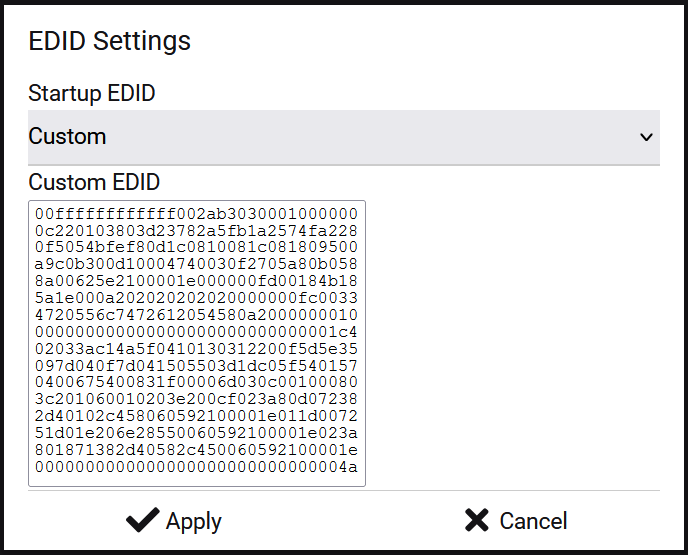
- Custom EDID – Manually apply a specific EDID hex string
The Default EDID can be restored at any time through the Encoder webUI.
These instructions apply to devices running justOS firmware (B2.x.x). Devices using legacy Ax.x.x firmware should instead follow How to Modify the EDID for 2G Series Encoders.
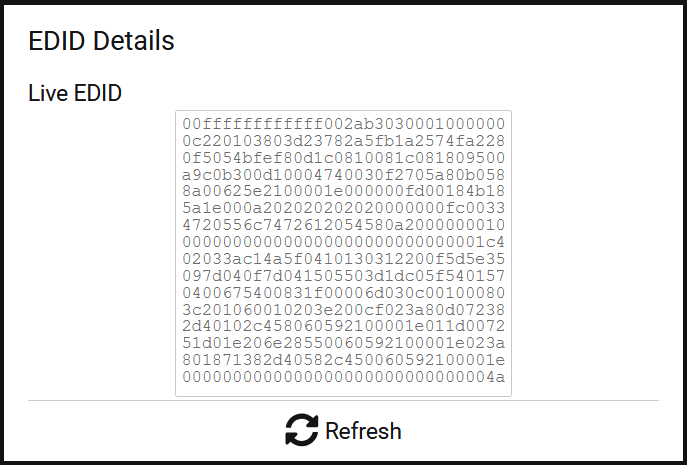
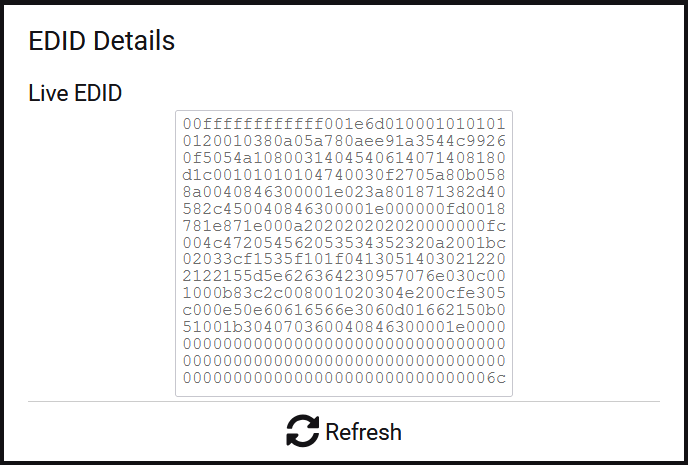
View Active EDID
The currently active EDID on an Encoder can be viewed using the webUI:
- Log into the Encoder webUI
- Navigate to the Video tab and expand EDID Details
- The active EDID is displayed as a hexadecimal string
- After making changes, select Refresh to update the displayed value
Built-In EDID
Ultra Series Encoders include a library of built-in EDIDs designed for common video and audio configurations.
To apply a Built-In EDID:
- Log into the Encoder webUI
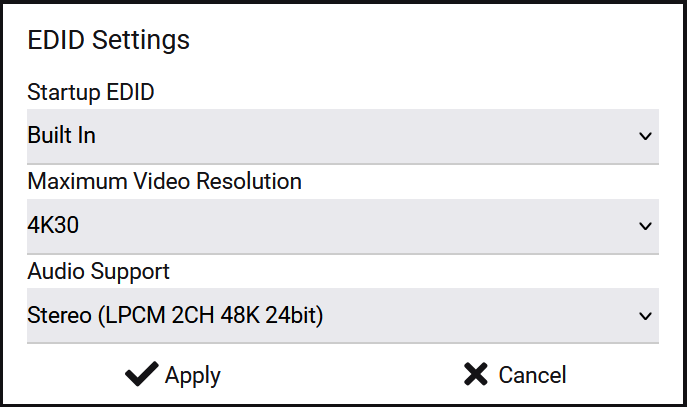
- Navigate to the Video tab and locate EDID Settings
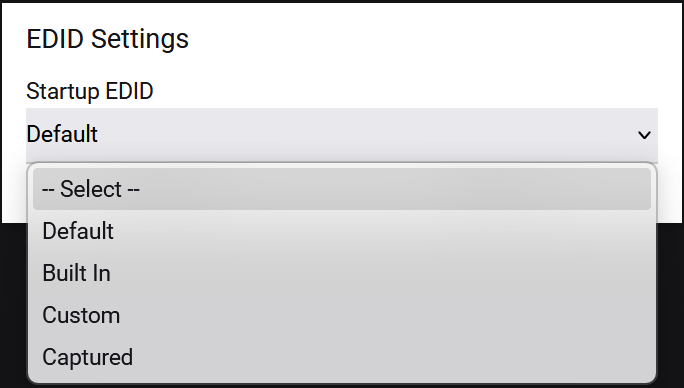
- Select one of the following EDID modes:
- Default – Maximum capabilities of the Encoder (model-specific)
- Built-In EDID – Manually define supported video and audio formats
- Custom EDID – Apply a user-defined EDID string
- Capture EDID – Copy EDID from a connected display
- Select Built-In
- Configure the maximum Video Resolution and Audio Format:
- Stereo – LPCM 2-channel, 48 kHz, 24-bit
- Multichannel – 5.1 DD/DTS, 7.1 Dolby Atmos/DTS/DTS-HD, LPCM 8-channel 48 kHz 24-bit
- Select Apply to activate the EDID
The Encoder updates immediately; however, some source devices may require a power cycle to recognize the new EDID.
Available options depend on the hardware capabilities of the Encoder model.
Capture EDID
Capture EDID copies the EDID from a display connected to a Decoder and applies it to the actively viewed Encoder. The source device then detects the Encoder as if it were directly connected to that display.
To capture an EDID:
- Access the Decoder webUI connected to the target display
- Navigate to Video Settings → EDID Settings
- Select Capture

The EDID is applied immediately, though the source device may require a power cycle to acknowledge the change.
Custom EDID
Custom EDID allows direct entry of a hexadecimal EDID string. The string must be continuous, with no spaces or line breaks. This method is recommended when precise control over video and audio capabilities is required.
Example: The following EDID requests 4K HDR video with Dolby Digital 5.1 audio, commonly used with Apple TV:
00FFFFFFFFFFFF002AB3003000000000141E010380A05A782AEE91A3544C99260F505421080081C08100818090409500B30001000101023A801871382D40582C450040846300001E000000100000000000000000000000000000000000FD00183C1E5A1E000A202020202020000000FC00484449502D313038302D322E3001DE02032DB14A901F20051404131E030123090404830100006A030C001000B83C211000E2000FE305C000E3060501023A801871382D40582C450040846300001E00000000000000000000000000000000000000000000000000000000000000000000000000000000000000000000000000000000000000000000000000000000CCTo apply a Custom EDID:
- Log into the Encoder webUI
- Navigate to the Video tab and locate EDID Settings
- Under Startup EDID, select Custom
- Paste the EDID string into the Custom EDID field
- Select Apply
- Power cycle the source device if required
- (Optional) Verify the applied EDID under EDID Details and select Refresh